
 Blog
Developmental Editor for Fiction: What They Fix Before Line Edits
Oyster Book Publishing is a ghostwriting and book publishing agency based in Allen, Texas, helping first-time and established authors turn ideas, manuscripts and life experience into professionally developed books.
Get a Free Consultation
with an Oyster publishing specialist
Free consultation. Clear quote before any work begins.
You have finished a novel, revised it twice and still sense that something is not working, but you cannot say what. This is the moment a developmental editor for fiction is most useful. Unlike a proofreader or copy editor, a developmental editor reads your whole manuscript and tells you what is happening at the level of story: structure, characters, pacing and stakes. This guide explains what they fix, why it happens before line edits, and how to hire the right one.
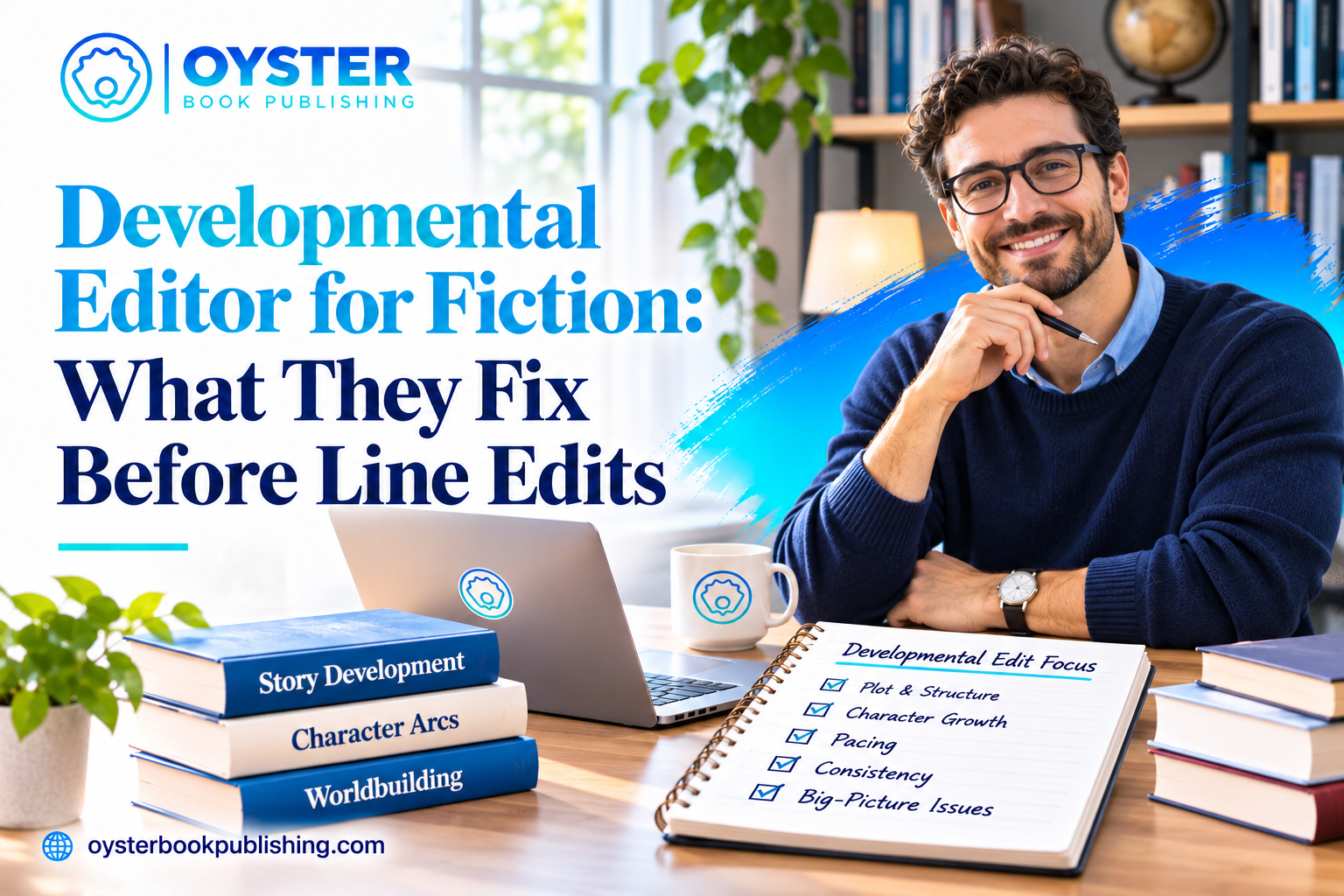
What a Developmental Editor Does
A fiction developmental editor studies the architecture of your book. They read the full manuscript, identify what works, and explain what is holding the story back. At Oyster Book Publishing, our editors read your entire manuscript before touching a single sentence, so recommendations come from understanding the whole book rather than a few chapters.
Typical output is an editorial letter that summarizes the main issues and priorities, along with comments throughout the manuscript. This kind of manuscript critique gives you a revision plan instead of a list of small corrections.
You may also see this role called a developmental book editor, a structural editor or a content editor. The titles differ, but the job is the same: improving the story itself before anyone refines the sentences.
Signs Your Manuscript Needs Developmental Editing
- Beta readers report losing interest in the same chapters.
- You can summarize the plot but not explain what the main character wants.
- Agents or readers say the book is “close” without saying why.
- Revisions keep fixing sentences but the book still feels flat.
What They Fix Before Line Edits
These are the problems a professional developmental editor looks for, most of which no amount of sentence polishing can solve:
- Plot holes and unmotivated events: things happen because the author needs them to, not because the characters would do them.
- Sagging middle: scenes that repeat the same tension without raising stakes.
- Flat or inconsistent characters: arcs that do not build, or choices that contradict earlier behavior.
- Unclear stakes: readers do not know what the protagonist stands to win or lose.
- Information dumps: world details or backstory delivered in blocks that stop the story.
- Point-of-view slips: unintentional head-hopping that confuses readers.
Targeted plot and pacing edits might move scenes, cut chapters, add missing scenes or reorder the timeline. These changes are far cheaper to make before anyone polishes the prose.
In a typical scenario (a composite, not a specific client), a debut fantasy novelist submits a 95,000-word manuscript with strong prose but a first act that takes 30,000 words to begin the main conflict. A developmental editor recommends cutting and combining early scenes, which moves the inciting event much sooner. The writing was never the problem. The structure was.
Developmental Editing vs Line Editing
Understanding developmental editing vs line editing helps you spend money in the right order. Developmental editing deals with the big picture, such as what happens, to whom and in what sequence. A line editing service then refines the prose within that structure, working on rhythm, word choice, clarity and voice. If you line edit first, you may pay to polish scenes that are later cut or rewritten.
Think of it like building a house. You do not paint walls before the framing is approved. Our developmental editing and line editing services are designed to follow in that order.
What You Should Receive
- A written editorial letter that explains the main strengths and issues.
- Comments in the manuscript that point to specific scenes and passages.
- A clear priority list, so you know what to revise first.
- Defined scope in writing, including any follow-up review of your revisions.
Beta Reader Services and Sensitivity Readers for Hire
Beta reader services provide readers from your target audience who report where they felt bored, confused or moved. They are most useful before or alongside a developmental edit because they show you how the book lands. Our beta reader service is built for this.
Sensitivity readers for hire review a manuscript for inaccurate or harmful portrayals of identities or experiences outside the author’s own. They do not censor a story. They help you avoid errors and stereotypes. Consider one when your characters or setting draw on lived experience you do not share. Our sensitivity reading service covers this.
Comic Book Editing Services
Comic book editing services apply the same principles to a visual format. An editor reviews script structure, panel-to-panel pacing, dialogue economy and whether the story reads clearly without too much text. Issues such as unclear action sequences or crowded panels are best fixed at the script stage. If you are writing a comic, explore our comic book writing service.
Where Proofreading Comes In
A proofreading service is the last step, after the story and prose are final and the pages are laid out. It catches remaining typos and formatting slips. It will not fix structure, which is why proofreading belongs at the end, not the beginning. See our proofreading and complete book editing service pages for the full sequence.
How to Hire a Developmental Editor
- Ask for a sample edit or sample editorial letter.
- Check experience in your genre.
- Confirm what is included, such as the letter, in-text comments and a call.
- Ask how long the edit takes and what happens if you revise and want another look.
- Get pricing in writing and itemized.
Frequently Asked Questions
After you have completed a full draft and revised it as far as you can alone, but before line editing or proofreading.
No. A developmental editor gives guidance and you make the changes, so the book stays yours.
Not always. Experienced authors with trusted readers sometimes skip it, but most debut novelists benefit from one.
Get a free quote for a manuscript assessment and tell us about your novel.
Ready to Turn Your Idea Into a Published Book?
Tell us where your book stands today. You will get a clear, itemized quote before any work begins, and you keep 100% of your rights and royalties.
Related Blogs
Explore Our Blogs

Custom Ghostwriting for Business Books That Build Your Authority
You know your industry better than almost anyone, and you have never found the weeks it would take to turn that knowledge into a manuscript.
Questions to Ask a Self-Publishing Company Before You Sign Anything
Choosing a self-publishing company is one of the few decisions in your publishing journey that is hard to undo.

How to Choose Amazon KDP Keywords and Categories for a Debut Novel
Your debut novel can be excellent and still go unnoticed if readers cannot find it. On Amazon, discovery depends heavily on the information.

U.S. Copyright Office Registration for Self-Published Authors
You have finished your manuscript and someone asks the question every author hears: is it copyrighted? The short answer is yes
Board Book Printing for Children’s Authors: Formats and Costs
You wrote a gentle book for toddlers and now you want to hold it, with thick pages that survive being chewed and thrown.